STRATEGIC PAPER · CAPITAL ARCHITECTURE

Fully funded. Fully governed.

Capital does not protect a programme when it is released ahead of evidence or separated from operating control.

This model links financing, clinical milestones and governance so capital is committed against observable progress and investors can distinguish execution risk from scientific risk.

A faceted blue gemstone examined under precision light, revealing internal fractures and hidden value.
THE EXECUTION GAP

Funding can amplify weakness as easily as strength.

Startups and mid-caps rarely fail because the science is worthless. They fail at the junction of capital intensity, operational complexity and weak governance.

01 · Capital and timing

Underfunded programmes hit financing cliffs before reaching value-inflecting milestones. Overfunded programmes can lock weak assumptions into motion.

02 · Operational fragility

Fragmented vendor architecture creates avoidable variance and amendment cycles.

03 Governance deficit

Evidence packages that are not partner- or payer-credible destroy downstream value.

THE MODEL

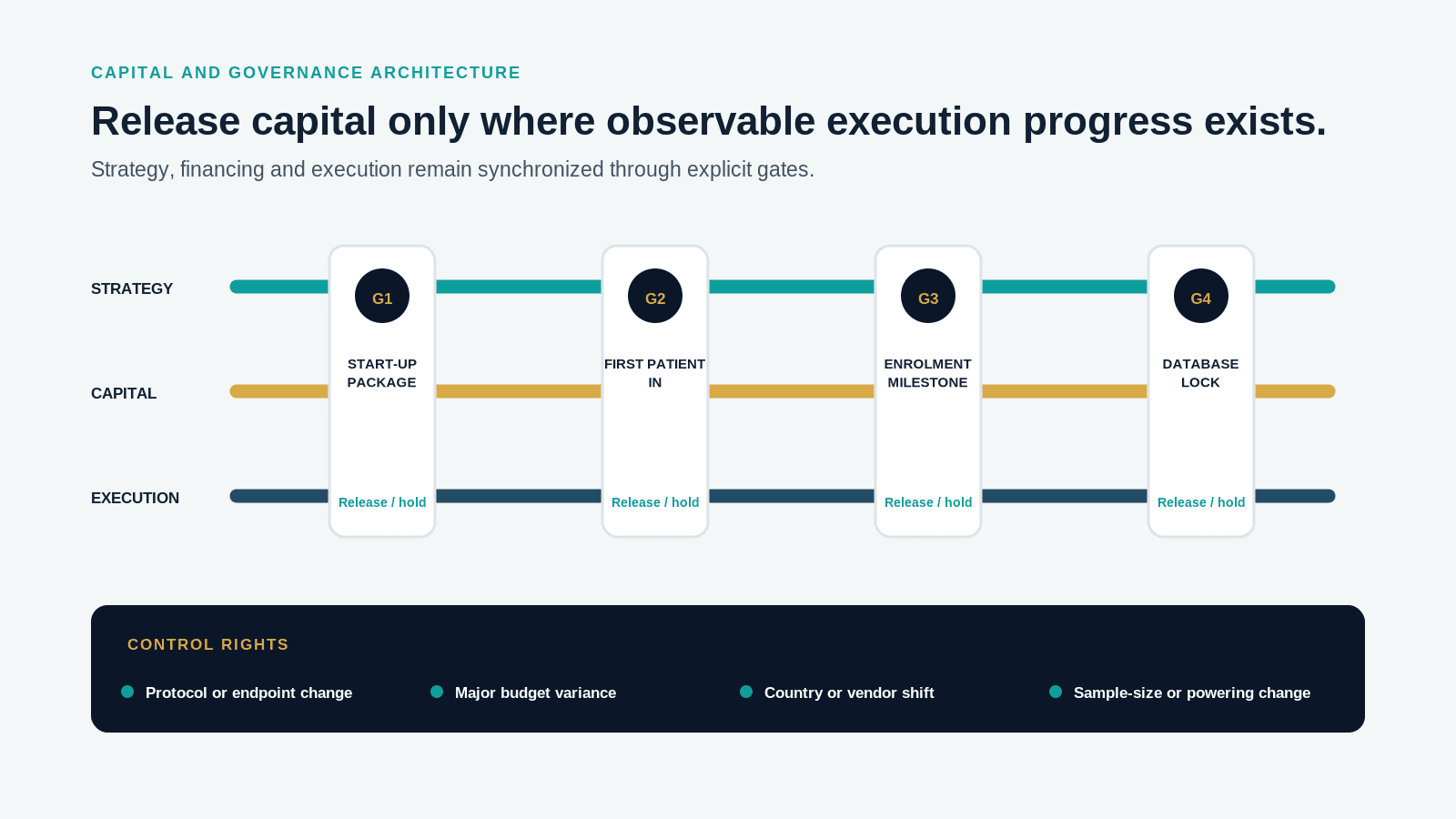
Release capital only where observable execution progress exists.

Strategy, financing and execution remain synchronized through explicit gates. The release, hold or redesign decision is governed before the next tranche of irreversible spend.

Capital is released through four execution and evidence gates rather than optimism.
WHO DOES WHAT

Different mandates. One governance logic.

Investor group

Funds the approved programme, holds defined governance rights and reviews milestone-linked progress rather than activity volume.

MB&P

Screens and pressure-tests opportunities, aligns investment-grade development plans, endpoints, budgets and payer logic.

Verum

Contracts and controls execution, quality, escalation and delivery evidence across vendors and geographies.

WHY THIS PROTECTS CAPITAL BETTER

Structural waste is removed before it compounds.

No stop-start execution

Committed tranches remove the funding gaps that stall enrolment and timelines.

Fewer avoidable amendments

Investment-grade design up front reduces costly mid-study protocol changes.

One quality logic

A unified governance spine eliminates inconsistent escalation paths.

Decision-grade artefacts

Governance documentation is built throughout so acquirers and partners do not have to reconstruct the programme later.

BEST-FIT SITUATIONS

Use the model where execution and capital dependence are inseparable.

Operationally fragile asset

The science remains credible, but the sponsor cannot run a disciplined global programme alone.

Valuation-sensitive timeline

Timeline credibility directly affects asset value and partner interest.

Governance-driven investor

Capital providers want defined control levers rather than black-box programme exposure.

Partner-ready evidence

Value depends on moving from early signal to a clean, diligence-ready clinical package.

NEXT STEP

Fund the programme without surrendering governance.

Pressure-test whether the asset is genuinely ready for disciplined clinical development, then define the capital-release structure, control rights and evidence package required at each gate.