INSIGHTS · PUBLICATIONS

Evidence, methods and judgment you can interrogate.

This library is organised by the decision a reader needs to make, not merely by publication date.

It brings together peer-reviewed research, strategic papers and public analysis across clinical development, execution governance, Medical Affairs, capital architecture, neurology and sleep medicine.


Cinematic library and research desk with scientific papers, books and analytical materials, representing publications, evidence and informed judgment.
HOW TO USE THE LIBRARY

Start with the question. Then choose the evidence.

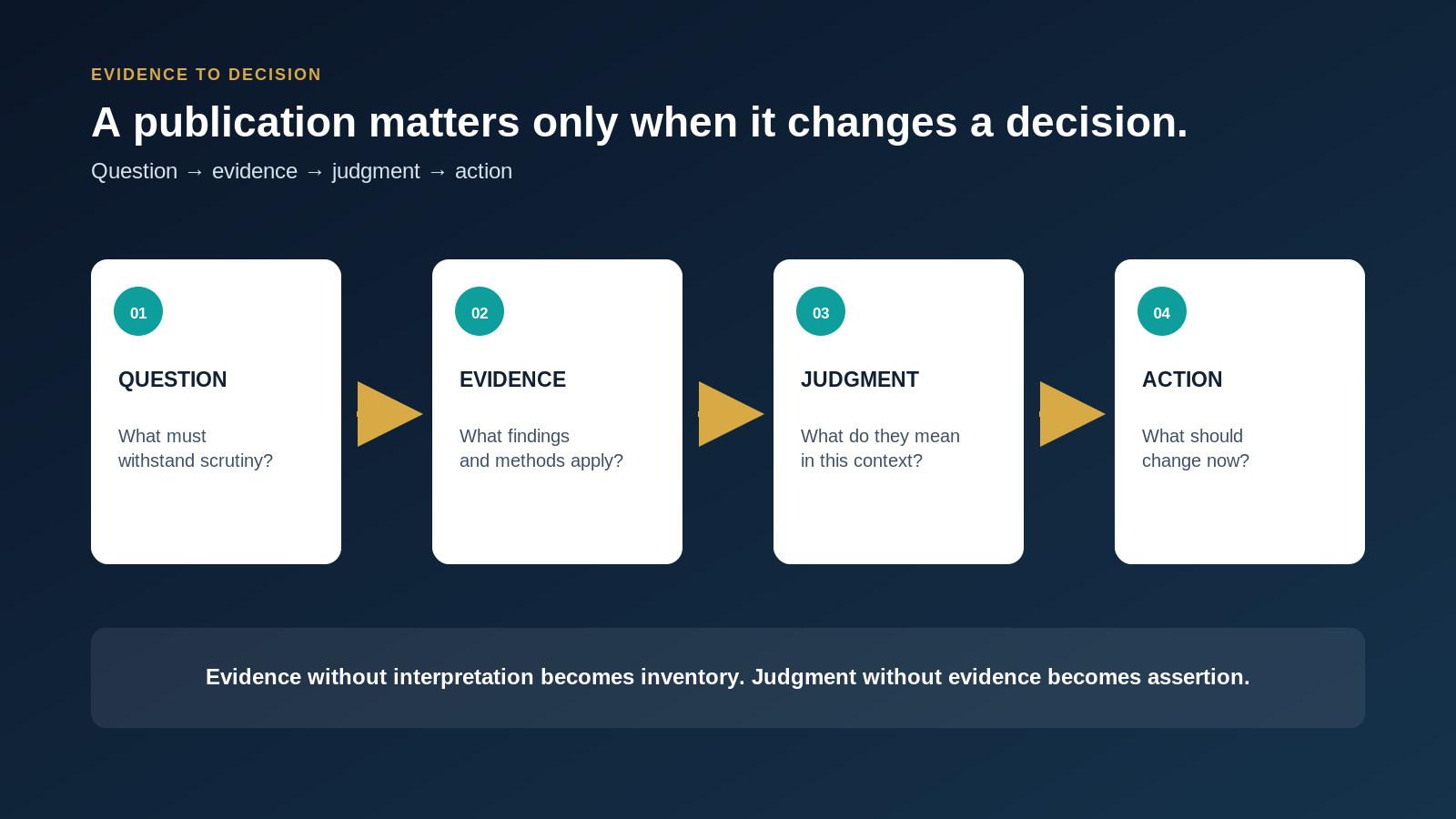
Evidence without interpretation becomes inventory. Judgment without evidence becomes assertion. The purpose of this library is to connect both to consequential decisions.

Four-stage evidence pathway showing question, evidence, judgment and action.
FEATURED STRATEGIC PAPERS

Three system problems. Three practical architectures.

From Strategy to Controlled Execution

Why credible clinical-development plans break at the translation boundary, and how one governance system connects design, execution and qualified local delivery.

Fully Funded. Fully Governed.

A capital and governance architecture that links financing milestones to observable execution progress and protects decision value.

Technically Strong. Strategically Marginalized.

Why Medical Affairs remains downstream despite technical competence, and which decision rights restore scientific authority.

FORMATS AND EVIDENCE STATUS

Not every document makes the same kind of claim.

The format is always identified so readers can distinguish formal evidence from applied strategic interpretation and illustrative case material.

Peer-reviewed research

Original research, reviews and methodological work. Claims remain bounded by methods, population and publication context.

Strategic papers

Structured operating models developed from evidence, repeated execution patterns and senior clinical-development practice.

Public analyses

Timely examination of industry decisions, policy, trial architecture and organisational failure modes.

Case snapshots

Anonymised examples showing how a problem was diagnosed, what changed and what decision value was protected.

APPLY THE EVIDENCE

A publication can clarify the problem. A live programme still needs a decision.

Bring the paper, assumption or development question that matters. The first conversation should establish what the evidence supports, what remains uncertain and what action is justified.