STRATEGIC PAPER · OPERATING MODEL
A clinical-development strategy creates value only when its logic survives translation into countries, sites, vendors, quality controls and daily decisions.
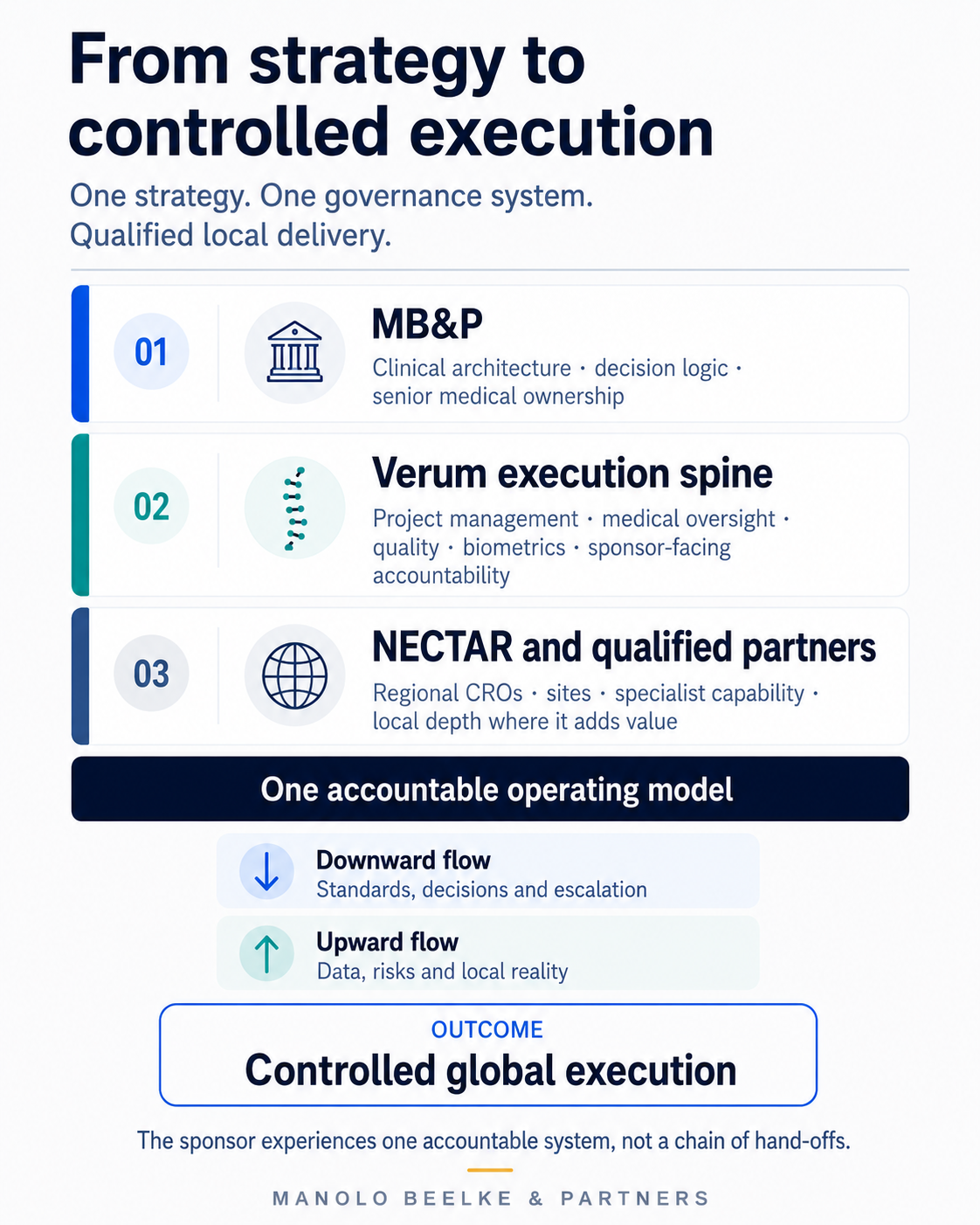
This paper defines an operating model in which MB&P owns the clinical architecture, Verum provides the execution spine and qualified local partners add depth where it changes performance.
See the operating model
Book a 20-minute Clinical Decision Diagnostic
 WHY GOOD STRATEGIES FAIL
A programme can look convincing in the boardroom and still break in execution. Most failures arise where strategic assumptions are never translated into operating rules.
01
Regulatory, operational, payer and investor requirements are developed separately, producing a study that may complete but cannot carry the intended decision.
02
Feasibility becomes aspiration. Country and site choices are disconnected from protocol burden and competing studies.
03
Endpoint and estimand logic remain in the strategy deck instead of being converted into site, patient and data-collection reality.
04
No single accountability structure catches drift while it is still inexpensive and reversible.
THE OPERATING MODEL
The sponsor should experience one governed system, not a chain of hand-offs. Strategic order flows down. Evidence, variance and accountability flow up.
 WHY THE MODEL IS MORE EFFICIENT
01
Commitments are locked only after country, site and patient-flow assumptions are challenged.
02
Activation is governed as an evidence-critical phase, not handed off as clerical work.
03
Standards, critical data and escalation remain consistent across partners and geographies.
04
Variance is surfaced while the programme still has affordable options.
WHEN TO USE THIS MODEL
The design and initiation window does not permit iterative correction.
The strategy remains plausible, but recruitment, vendor, quality or governance alignment is weakening.
Country and site architecture will determine access to the right patients and the credibility of execution.
The clinical thesis is credible; the unresolved question is whether the operating plan can withstand scrutiny.
NEXT STEP
Bring the clinical thesis, protocol or execution plan. We will identify which assumptions have not yet been translated into executable decisions and whether the governance model can protect the intended readout. See the clinical development strategy mandate, trial rescue mandate and governance model.
Book a 20-minute Clinical Decision Diagnostic
Explore services